
In the modern digital landscape, network uptime is not a luxury—it is a non-negotiable requirement for business continuity. This is especially true for companies operating in the Philippines, where the reliance on stable connectivity often clashes with the reality of occasional internet instability, regional infrastructure limitations, and frequent weather disturbances.
For network administrators, the solution lies in embracing redundancy and high availability (HA). This strategy ensures that if any single component fails, a backup is immediately available to take over, preventing costly downtime and maintaining uninterrupted service delivery.
Understanding High Availability (HA) in Networking
High Availability is a system design approach that minimizes downtime by eliminating Single Points of Failure (SPOF). If one component—be it a firewall, a server, or an internet connection—fails, the network automatically and seamlessly switches to a secondary, redundant component.
The two most critical areas where redundancy must be implemented are the network's external connections, which ensure continuous internet access, and the internal network hardware, which ensures internal resources remain accessible.
1. External Redundancy: Combating Unreliable Internet
Unreliable or low-speed primary internet connections are common challenges in many Philippine regions. Implementing connection redundancy mitigates this risk effectively, ensuring mission-critical services remain online.
A. Multi-Homing with Diverse Carriers
The most fundamental step is subscribing to internet services from two or more completely separate Internet Service Providers (ISPs). Ideally, these connections should use diverse connection types, such as one fiber line and one wireless or cable line. This ensures that if one ISP experiences an outage, perhaps due to a physical line cut or regional failure, the secondary link instantly maintains business operations. Crucially, administrators should ensure the physical lines from different ISPs enter the building via separate physical paths to prevent a single point of damage (like a construction accident) from cutting both connections simultaneously.
B. Implementing Load Balancing and Failover
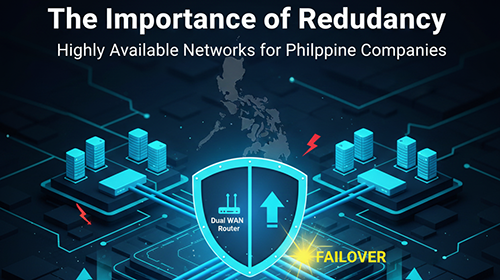
Redundancy is managed by a dedicated device, typically a Dual-WAN router or a specialized firewall appliance. This appliance supports two core functions:
Automatic Failover: The appliance constantly monitors the primary connection. The moment it detects a drop, it automatically routes all traffic over the secondary (redundant) connection. This transition is often fast enough to prevent a disruption to ongoing video calls or critical transactions.
Load Balancing: This allows both internet links to be used simultaneously. Traffic is distributed between the two links, which effectively addresses the issue of low speed by aggregating bandwidth. This improves overall network performance and efficiency during peak business hours.
2. Internal Redundancy: Securing Core Network Infrastructure
External redundancy is useless if the internal hardware that manages the network fails. Therefore, redundancy must be applied to critical internal devices:
Firewalls and Routers: Since these are the network's gatekeepers, a single device failure leads to total network shutdown. The solution is Active-Passive Clustering, where two identical units are connected. One acts as the primary (Active) and the other as the secondary (Passive), ready to take over within seconds of a failure.
Core Switches: These devices control all internal data flow. A single failure isolates entire departments. Administrators should utilize high-availability switches that can be "stacked" to act as a single logical unit, or ensure critical switches are equipped with redundant power supplies.
Servers: These host critical applications such as ERP systems, inventory management, and file shares. Clustering and Virtualization are key solutions here. Utilizing virtualization platforms (like VMware or Hyper-V) combined with server clustering allows virtual machines to instantly migrate to a working host server upon failure, ensuring business continuity.
The Business Impact of Investing in Redundancy
For Philippine companies, the cost of implementing this level of redundancy is easily justified by the prevention of significant operational and financial losses.
First, establishing external redundancy with multiple carriers means sustained revenue, as critical services like e-commerce platforms and payment gateways remain online during ISP outages. Second, internal hardware redundancy eliminates Single Points of Failure, leading to increased productivity by preventing the lost man-hours that result from network-wide downtime.
Furthermore, utilizing load balancing directly addresses low speeds by aggregating bandwidth, resulting in an improved user experience for bandwidth-intensive applications like VoIP and cloud services. Ultimately, building a resilient network acts as a safeguard, ensuring business continuity and protecting mission-critical data.
Designing a highly available network is no longer an optional upgrade for companies operating in the Philippines; it is a fundamental pillar of risk management. By strategically implementing multi-homing for external connections and active-passive clustering for critical internal hardware, network administrators can build resilient infrastructures that consistently deliver excellent service, even in the face of unpredictable connectivity challenges. Investing in redundancy is investing directly in the stability and future growth of the business.













 December 10, 2025 - BY Admin